Showing posts with label Mozambique. Show all posts

Friday, February 20, 2009

Photos of Mozambique - Dec 2008 / Jan 2009


We will put a gallery of full-size photos on Flickr as soon as we have a good enough internet connection.

Tuesday, January 13, 2009

Border crossing from Mozambique to Tanzania in Songea

The border post at the new bridge in Congresso had not been officially opened yet. The immigration officers on the Mozambiquan side were working out of straw huts, while new offices were being built. However, crossing the border from Mozambique into Tanzania went easily. They stamped our passports, and suggested we leave them our unused Mozambican airtime, before letting us go without no further searching of Scarlet.

On the other side of the bridge a Tanzanian official working out of an isolated snack-bar, wrote down our names, passport and license plate numbers. We were told to report to immigration Songea, 102km away.

We arrived in Songea after 4pm. What we thought was the immigration office was closed. “When will it open?” we asked. “Saa Mbili.” we were told. Impossible we thought, and checked with someone else – same answer. This was our first introduction to Swahili time – 7am is the first hour of the day, 8am the second etc etc. We spent the night at a Catholic abbey about 20km out of town.

The next morning we drove back into Songea to report to the immigration immigration office. We found it eventually, located in the Ministry of Finance’s buildings. The officials were friendly enough. We completed our forms and were told to go and pay the 50 US$ visa fee (each) at one of the local banks. They would stamp our passports when we brought back the deposit receipts.
We had to admit that this is a very good system to prevent corruption. Although, walking across town in the heat and queuing there for an hour to pay the fee, didn’t really seem worth it.
We got our receipts, and went back for our stamps. You can normally get a multiple-entry 3 months visa for 50 USD, but the officer told us he didn’t have the authority for the multiple-entry, and gave us a 1-month single-entry visa instead.

We’ve now been busy for 2 hours and haven’t had breakfast yet, but we need to go through customs first. The customs officer normally works out of the Post Office. We found the Post Office but the officer was on holiday and we were directed to the TRA (Tanzanian Revenue Authority) instead and another long queue. No-one there really knew what to do with our Carnet de Passage (CDP). After we had waited for almost an hour, someone from the car licensing department came over with the necessary forms, a wad of carbon paper for several copies, and a box of stamps, and proceeded to register our car.

We were then told to go to the bank again (a different one) to pay a 25 USD fuel levy before we could have our CDP stamped. So off we went, queued patiently, paid, and eventually got a receipt, and our stamp.

The whole process had taken us over 5 hours and we were about to happily get something to eat and drink and be back on the road, when the officer who stamped our CDP asked to see the car, which was still parked at the Ministry of Finance! We fetched the car and reported for our inspection. Fortunately this only took a few minutes, and by 12 o’clock we were on our way to Iringa and the Old Farm House campsite, our patience tested to the limit.

Sunday, January 11, 2009

Hippos and crocs on Lago Niassa (Lake Malawi)

When we first arrived at Lago Niassa, we basked in its peace and beauty. Little could we imagine that a few days later we would be joining a hunt for hippo and crocodiles.

It just so happened that the government had approached Keith, and asked him to help rid the village (Meponda) of a hippo that was causing extensive damage to people’s crops. And this was the weekend that he and his neighbours (Warrick, an ex-hunting lodge manager, and his father, also Keith) had chosen to go on the hunt.

We joined in the Friday night festivities to get into the swing of things. We all jumped on the boat and motored along the lakeshore looking for crocodiles. We spotted one amongst the reeds. It was small (about 1m) and our hosts leapt fearlessly from the boat to apprehend the little guy barehanded. Somehow, the snorkelling we had enjoyed earlier that afternoon felt like much more of a dangerous adventure than what we had thought it to be.

Then on Saturday afternoon, men, women and children, all jumped on the boat again. This time we were going to drive down the river mouth and look for the hippo so that the men would know where to find him in the evening. It had rained over the past few weeks and the river was brown with mud. It was difficult to spot a hippo in those conditions, but the reeds and river banks showed evidence of the hippo’s presence. We travelled as far as we could up the river, asking local fishermen on their tiny dug-out canoes if they had seen the hippo.

Yes they had. Some said there were 5 hippos. Others said there were 30… Eventually one motioned for us to go back towards the river mouth. He had just seen a hippo in the river!

We started carefully back down the river, looking for eyes or bubbles in the water, when suddenly the boat hit something big! The jerk shook the boat quite strongly and Steve fell over board in the muddy water. We all held our breath as he re-emerged. We were expecting the hippo’s charge. Steve couldn’t decide whether to swim or run back to the boat, but somehow made it back on board. Then we realised that we had just hit a big log.

It lasted for just a few seconds but we all got a serious fright. One of the girls soon started singing and the mood lifted. They sang the song again for us as we parted, and we recorded it:

VIDEO of the song
http://www.youtube.com/watch?v=Frtu11EIozY


The “smoke” in the background is actually swarms of lake flies which hatch periodically from the lake. The locals catch them in nets and eat them.

Lago Niassa / Lake Malawi

After the rather difficult drive through Northern Mozambique, we have found a piece of paradise on the shore of Lake Niassa, better know as Lake Malawi. Its waters are fresh, pure and transparent.

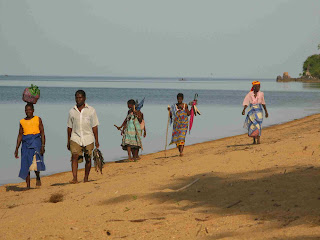
We are staying in Meponda, a small fishermen’s village. Keith and Bronwyn have generously let us set camp under their baobab. What was to be a one night stop has become a five day holiday within a holiday. We kayaked, snorkelled, water-skied, and went crocodile and hippo hunting!

Thanks a million to all of you there!
Bronwyn, Keith, Zoe and "Dog"
Abubakar / Daniel
Lazaro Water-skiing with new friends

And the place in images :


Wednesday, January 07, 2009

The road from Montepues to Lichinga

We left the Mozambican coast at Ibo and ventured inland to the west. Our goal was to drive across Northern Mozambique to Lago Niassa (Lake Malawi) before the rains make the road impracticable. There we could rest there before heading North to Sanga and across the new bridge to Tanzania.

But first we had to get to Marrupa! It was to be quite an adventure: two full days to do 500km, a slow difficult road, dodgy wooden bridges, two breakdowns, and two nights in the bush in very isolated areas.

General view of the main road

Detail of the main road Dodgy bridges (Caro scouting one of them)

Curious villagers (Scarlet is an attraction)
Warning: elephants crossing Cooking in the bush

Caro shot some videos en route:

One to give you an idea of what the main road across northern Mozambique is like (approx 300km between Montepues and Marrupa) …and we were lucky that it was relatively dry!

VIDEO of the road
http://www.youtube.com/watch?v=NY7bqOVYYXU


… And one about what happens when a branch jumps up of the road and lodges itself under the car.
Fortunately there was no serious damage to the brakes or fuel lines, tanks etc.

VIDEO of the breakdown
http://www.youtube.com/watch?v=cQgvDMVfJ9M


Fortunately, once we got out of the forest at Marrupa, we found the best tarred road yet in Mozambique! It took us straight to Lichinga across stunning landscapes of high plateaux.

Images from the high plateaux

Monday, January 05, 2009

Ibo Island and the Quirimbas National Park

The Quirimbas Archipelago lies some 80km North of Pemba. We had heard that Ibo Island was worth a visit. Some people encouraged us to fly there, but we decided to give the road a try. We found it to be very practicable when dry, although had it have rained we probably wouldn’t have gone through.

A bus stop (“paragem”) on the road to Quissinga

“Take the road to Tanganyanga, and carry on across the salt pan straight to the baobab on the beach,” we were told. “There you will find a barraca where your car will be safe. Someone will be able to help you hire a dhow to get across to the island.”
It was as we had been told…

The baobab on the beach

…and we hired a motor boat to go across to the island. Only to find out later that there is a ferry, called a chiapa, that would have cost us a tenth of the price! So we learn.

Like Ilha de Mocambique, Ibo used to be an important trading post in the Indian Ocean, and a main governing base for Mozambique in colonial time. The Indians, Chinese, Arabs and Portuguese established themselves on the island over the centuries. They traded cashew nuts, gold, ivory and slaves from the mainland. When the Portuguese left, the buildings were left to themselves.


Ibo’s streets

Ibo aroused our interest and curiosity about Mozambique’s past and present more than any other place we had visited so far. A local teenager, Abu, became our guide and told us a bit about his homeland and his people.

Abu Making lime to restore the Fortaleza

Cowries on the governor’s house

It is a stunning area. The archipelago is virtually unspoilt, and it must be a pleasure to sail through the area. The Quirimbas National Park has been set up to protect and manage its biodiversity and history.

The mainland part of the park is also beautiful. The next day we drove east from Quissinga through the park. We filled our water tank at one of the villages, and camped in the bush.


Villagers Child Bush bath

Sunday, January 04, 2009

Londo (last day in Pemba)

We spent a few days in Pemba, relaxing at Brenda and Rudy’s Pemba Dive + Bush Camp.
We enjoyed its stunning private beach on the bay…

Pemba Dive + Bush Camp private beach

…and the mud bath in the mangrove!

Mud bath

It is a favourite hangout for the local expats. And we met interesting characters. Also, it wasn’t long before we met Guy and Kerryn, who we found out to be friends of friends. They invited us to spend a day with them on Franz’s dhow. We sailed to Londo across the bay and spent the day fishing, snorkelling and exploring.

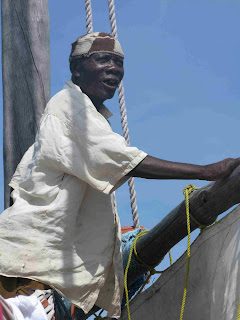
Franz’s dhow On Franz’s dhow Captao Pemba Bay