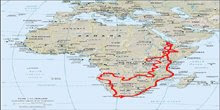
We were impressed by the quality of the roads. They are excellent, and where there is roadwork the diversions are clear and good.
What struck us when we arrived was how green, hilly, and productive the countryside looks.
But, what will stay with us the most is the people’s kindness, helpfulness, and their smiles. Uganda is diverse and beautiful: stunning National Parks, thrilling rapids, unique birds, mysterious Chimpanzees and Gorillas, snowy mountains (the Rwenzoris), and active volcanos, tree-climbing lions, crater lakes and Lake Victoria. It is no wonder that this is where Queen Elizabeth and Prince Philip chose to spend their honeymoon 60 years ago.
There are a few cell phone networks available, but Zain, which we used in Kenya and Tanzania is also present in Uganda. We are thus still using the sim card we bought a few months ago.
On 05 May 2009, the exchange rate was more or less:
- Ksh 1 (one Kenyan shilling) to Ush 26 (26 Ugandan shilling)
- USD 1 to Ush 2000
- ZAR 1 to Ush 200
And here are some prices:
- Ush 1700 to 4000 for a beer (supermarket to bar)
- Ush 700 to 1500 for a bottle of Coca Cola (local to Mzungu)
- Ush 1000 for a mango (Mzungu price?)
- Ush 1500 for a dozen bananas
- Ush 2100 to 2400 for 1l of petrol depending on dist from Kampala.
Showing posts with label First impressions. Show all posts
Showing posts with label First impressions. Show all posts
Friday, May 15, 2009

Tuesday, April 21, 2009
Impressions of Ethiopia
It isn’t easy to write about Ethiopia…and it isn’t easy to write about “first impressions” two weeks after coming back from a seven-week trip through the country…
Ethiopia is intense. It’s a fascinating country. It has a very old and rich history, and is home to a variety of people and languages. But the cultural shock is immense. We found that it is not an easy place to visit as an independent traveller.
We had heard the best and the worst about Ethiopia before our arrival. Most overlanders we had met hadn’t had much good to say about their journey; the roads were supposedly in a bad state and most felt unwelcome and hassled most of the time.
However, Ethiopia was one of our main goals for this trip. And our spirits were raised after reading the introduction to an old edition of The Bradt guide to Ethiopia by Philip Briggs.
Yes, there was hassling, yes there was shouting and screaming as you passed by or arrived in a village, and yes it sounded aggressive; but most of the time it was a matter of misunderstanding… According to Mr. Briggs, one had to keep an open mind, a sense of humour, and remember that there are good and bad people in Ethiopia, just like there are good and bad people everywhere in the world, and that the hassling or aggression we might encounter would be from a few individuals, and not a general characteristic of Ethiopians.
So, we entered Ethiopia, prepared to experience everything that would come our way with as open a mind as possible. We loved our first three weeks there. We loved the food: the tef pancake called “Injera” which is eaten with a variety of sauces and vegetables. We loved the people: those “Iou, iou” screams were a sign of the children’s excitement at seeing “Faranjis” – the equivalent of “Mzungus” (White men) in town. We even loved chatting and joking around with the three words of Amharic we had learnt whenever we were asked to “Give” something! We loved the tarred road, and the beautiful evening light which accompanied us from Moyale to Yabello on our first day in the country. We loved staying at the Bale Mountains National Park’s headquarters in Dinsho, as well as our 6 day trek there, with a wonderful guide and horse assistants. And we loved our first stay in Addis Abeba, its friendly people, coffee shops, fresh juices and pizzas.
Somehow, however the remaining four weeks wore us down completely. By the time we crossed the Kenyan border again around mid-April, we sighed with relief.
What got at us?
It wasn’t the lack of variety of the food on offer, although we didn’t enjoy Injera as much anymore. There was always the good old pasta and tomato sauce available...
It wasn’t the bad roads either. We are always up for an adventure. We are in no hurry and always drive slowly and carefully, and Scarlet did amazingly well.
It could have started with the kids throwing stones at our car. But kids are kids. Throwing stones at cars is a fun change from throwing stones at goats or cows. It’s difficult to blame them.
It could have been partly due to“cultural misunderstanding”. It’s not easy to control one’s instinctive reaction to what is perceived as aggression. The “Iou, iou” sounded like “You, you”, and the “Faranjis” shouted at us at every corner started to sound less and less like excitement, and more and more like unwelcoming screams…
It probably also was the frustration at not being able to have any “normal” relationship with anyone. It is exhausting to feel like people constantly want something out of you and at constantly being ripped off. Admittedly - and fortunately - there were many exceptions as well.
We began to feel a sadness that grew in us after seeing so many, many, many, people – not just individuals - holding their hands out or running after the car shouting “Give, give!” as we passed by.
And certainly the sadness grew each time we were taken for a ride by yet another person posing as someone who wanted to help.
Maybe it is just that we got tired of being on the road and lost our sense of humour. Who knows?! The best is always for you to go and see for yourself.
Now for some practical info:
Ethiopian time = Swahili time. That is: one o’clock in the morning is 7am, 6o’clock is 12am, one o’clock in the evening is 7pm, etc…
Ethiopians also use the Julian calendar, which is 7 years behind our calendar, with New Year on September 11. But that didn’t really affect us.
It really pays to learn a few words of Amharic. We would recommend that you carry a small guidebook with you. The most common words we have heard are:
“Ishee” is the equivalent of the Swahili “Sawa”. That is “OK”.
“Faranji” means “Foreigner”. It is applied to any white person. More or less the equivalent of the Swahili “Mzungu” although we couldn’t really figure out whether it was a respectful or derogatory term as it was often shouted at us with what sounded to us like an aggressive tone…
“Habbishat” means “Ethiopians”. We took to shouting it back at people when we started getting tired of the “Faranji Hysteria” (as Philip Briggs calls it in The Bradt guide to Ethiopia).
1 = and
2 = hulet
3 = sost
4 = arat
5 = amist
6 = sidist
7 = sabat
8 = simint
9 = zeten
10 = asir
11 = asir and
20 = haya
100 = meto
200 = hulet meto
1000 = shee
Exchange rate (in Feb/March 2009): Bir 10 = ZAR 10 = USD 1 (more or less)
Examples of costs (in Feb/March 2009):
1 coca-cola = Bir 4 to 5
1 injera with meat = Bir 13 to 20
Camping = Bir 20 to 25 per person
Hotel double room with shower = Bir 60 to 100
Diesel/Petrol = 65/75 Bir/l
We were warned repeatedly about the availability of petrol (benzeen) in Ethiopia – our car has a petrol engine. We were pleased to discover that it is available mostly everywhere, although the prices vary dramatically, particularly where it comes out of a barrel in someone’s backyard. The petrol stations do run out on occasion and so it is worth filling up whenever you find an official station with stock. We realised a good way of determining whether there was any petrol available in a town is to look out for motor bikes or tuk-tuks.
Driving in Ethiopia is an experience. Everywhere, the roads are shared with people and livestock, many of who are not familiar with road traffic and do something unexpected at the last instant. Our approach was to take it very slowly … It seems to have paid off.
Monday, February 09, 2009
First impressions of Kenya
To be honest, our first impression of Kenya is that it doesn’t differ much from Tanzania, except for that more people seem to speak better English. Although Swahili is also the lingua franca, English seems much more widely used than in Tanzania.
The services are polite and efficient, the roads relatively good, and we are finding everything we need everywhere. There are a few cell phone networks available, but the same Zain which we used in Tanzania is also present in Kenya (as well as in Uganda).
On 13 February 2009, the exchange rate was:
- Ksh 1 (one Kenyan shilling) to Tsh 16.6 (16.6 Tanzanian shilling)
- USD 1 to Ksh 78
- ZAR 1 to Ksh 8
- About Euro 1 to Ksh 100
Shopping for food in the streets is much more affordable than at supermarkets (and your money goes to individuals rather than big businesses). Below are a few ideas of prices (in the streets of Nairobi)…
- Ksh 50 for 1 Kg of tomatoes or onions
- Ksh 70 for 1Kg of potatoes
- Ksh 10 for a mango
- Ksh 5 for a banana
- Ksh 75.8 for 1l of petrol (It was around Tsh 1340 in Tanzania, and between Mt 36 and 40 in Mozambique)
The temperatures vary greatly depending on where you are. Nairobi is 1770msl and much cooler that at the coast. Yesterday was the first day I wore socks since we left Cape Town!
Sunday, January 18, 2009
First impressions of Tanzania - from Songea to Moshi
Our first impression is one of development. It must be the contrast with Mozambique.
There is no border post (as yet) on the Tanzanian side of the Macatchedj, the new bridge over the Rovuma River, and the Mozambiquan border control is housed in grass huts. We have to do the Tanzanian paper work in Songea, the next big town, 102km further North.
For a few kilometres we drive through virgin bush. The first villages we see have brick houses:
 Cows and a broken bridge
 Braaing in the bush after looking for a visiting elephant on TPC's land. With Fred, Caro, Bruno and Zia. And with Kilimanjaro in the background

 Tying up the surfboards on the bumpy road through Dodoma


 On the road from Dodoma

 Camping in the bush on the Masai Steppe
 The mountain road to Mbulu
 In Karatu, a fellow South African, Andre, hosted us. The two Masai men working for him were intrigued by our surf boards
There is no border post (as yet) on the Tanzanian side of the Macatchedj, the new bridge over the Rovuma River, and the Mozambiquan border control is housed in grass huts. We have to do the Tanzanian paper work in Songea, the next big town, 102km further North.
For a few kilometres we drive through virgin bush. The first villages we see have brick houses:
 Brick houses with corrugated roofs
People also have cows, dogs, and much more material goods than we have seen in the whole of Mozambique.
Cows and a broken bridgeSoon we also notice power lines along the road, as well as obvious signs of road maintenance. With the numerous small industries that seem to thrive in Songea, the picture is complete, the Tanzanian economy is way ahead of Mozambique’s.
We enjoy the local advertising style and spelling:
We enjoy the local advertising style and spelling:
 Fast and flesh
We thought we were back in English-speaking country, but everywhere Swahili (the local language) dominates. It is a beautiful language and we wish we understood and could speak a bit more. We are learning “Pole pole” (slowly slowly): “Karibu” (Welcome), “Asante sana” (Thank you very much), “Habari” (How are you?), “Mzuri” (Fine), “Wapi” (Where), and we can count to ten…
For bigger numbers we learn from the notes. The exchange rate is of 150 Tanzanian shilling (Tsh) for 1 rand (ZAR), that is about 1300 TSh to the USD.
The local cell phone networks have welcomed us. There is Tico, and Zain with its bright purple swirls.
So far we have only had one of the local beers. Not surprisingly, it is named after the Kilimanjaro. “It’s Kili time! Make the most of it.” says the advert. We follow the advice when we get to Moshi:
 Our first clear view of Kilimajaro from Fred and Caro's house in Moshi. It is normally covered by clouds as you can see on the picture below:
Braaing in the bush after looking for a visiting elephant on TPC's land. With Fred, Caro, Bruno and Zia. And with Kilimanjaro in the backgroundNot only do the markets and shops offer more choice, but costs are also much lower than in Mozambique. A Coca-Cola costs us Tsh 500, a cabbage Tsh 400, an hour on the internet Tsh 1000. Our best surprise is the cost of petrol: it is closer to South African costs, under 10 ZAR a litre. In Mozambique it was between ZAR 15 and ZAR 20 a litre, much more than we had budgeted for.
By now we are used to shopping at local markets, washing our fruits and veggies in clean water before we eat them, as well wearing long pants and long sleeves shirts together with anti-mozzie spray in the evening to avoid getting malaria.
We were carrying water from Lake Niassa (Lake Malawi). We had filled our 60l tank straight from the lake one morning, and purified it with a few drops of chlorine. We ran out of water shortly after Kondoa so we filled up from a well in the mountains at Mbulu. We haven't had any tummy problems yet. Waiting for our turn at the well near Mbulu
Otherwise, apart from the half-day stop in Songea to deal with the border crossing paperwork, we haven’t really had a chance to experience the Tanzanian culture yet. Generally people aren’t as smiley and friendly as in Mozambique, but they seem pretty relaxed nonetheless. Policemen haven’t cause and problems, although they always try their luck and cheekily ask: “What gift have we brought them from South Africa?” We just laugh with them and say that we’ve eaten all the Christmas cake. We would rather sit and wait rather than offer any bribes, and so far it’s been fine.
From Iringa we took the “bumpy” road North to Arusha through Dodoma and the Masai Steppe. This has allowed us to drive through isolated villages and to meet a few people along the road. To me, the most striking cultural experience so far, has been our timid encounters with a few Masai men. They are very tall and very beautiful. They also have a strange intensity about them. They walk fast in long loping steps, some occasionally ride a bicycle, and young boys herd cattle. They all carry sticks, long knives, and they all wear a blue or purple cloth/dress (different from the traditional red). We re amazed that they survive in this dry thornbush environment and look forward to learning more about them.
Below are a few pictures taken on the road between the border and Moshi:
The road opening onto the Masai Steppe
Tying up the surfboards on the bumpy road through DodomaHelping out fellow travellers on the road
On the road from Dodoma Camping in the bush on the Masai SteppeThe mountain road to Mbulu In Karatu, a fellow South African, Andre, hosted us. The two Masai men working for him were intrigued by our surf boardsTuesday, December 16, 2008
1st impressions of Mozambique - from Maputo to Tofo
Our first contact with Mozambique is physical - literally. After a few kms of smooth sandy tracks we hit a hard bumpy road. I am thankful I have packed sports bras.
 Yellow MCel-sponsored buildings everywhere
 Violette
We have a diner of fresh crabs and they tell us about their life here. It’s so different from South Africa. We can feel it already. It is difficult to describe, but basically there seems to be much more social mixity, and the Mozambicans are self-confident and seem happy with themselves.
The culture is a rich mix of African, Portuguese and Arabic. For example, Sandrine and Ronny’s house is right next to much poorer looking buildings. They have a guard but don’t seem too concerned about security. They say there is no violent crime.
After dinner they take us to a club where we listen to cool local jazzy music. We seem to be the only foreigners (and whites) but no one pays special attention to us. There is a great atmosphere, almost Latin. I imagine Brazil to be quite similar.
It’s chilled out yet elegant, urban and modern yet it feels like a well-established culture.
We know too little of the country’s history to make much comment. The communist influence is visible in the avenue’s names: Vladimir Lenin, Karl Marx, Mao Tse Tung… So is the liberation struggle: 24 de Julhio, Eduardo Mondlane…
These are early days and we are still feeling a huge distance with the people. I am reluctant to take photos: I don’t feel quite safe enough to take the camera out in the streets yet, and in any case it doesn’t seem right to point it into people’s faces. I prefer just to enjoy their huge smiles and friendliness.
Below are just a few first images:
Mon 15/12 – Tofo. Unfortunately and, despite our great expectations, there is again no surf to be had her. Instead, we do some maintenance and relaxation at the Turtle Cove, a stylish and very nice campsite with swimming pool and yoga lounge.
 Steve doing some daily maintenance on Scarlet.

 The Turtle Cove’s campsite’s yoga lounge.
 Our first baobab, near Inhambane
Sun 14/12 - On the road between Maputo and Xai Xai


Sat 13/12 – Maputo Costa do Sol
 Bumpy road to Boane
There is so much to learn when one enters a new country.
It’s a new language: “Bons Dias”, “Boa Tarde”, “ Obrigado/a”, “Fas favor”, “Es tu a pedir”…
It’s also a new currency. The toll gate exchanged our rands at 1 rand (ZAR) = 2.23 meticales (Mt) but the backpacker’s in Maputo gave us ZAR 1 = Mt 2.4
And it’s a new cell phone network. But this one isn’t hard to find about! MCell’s blue and yellow adorns most buildings in the rural areas and is advertised on most billboards (when it’s not Vodacom’s blue and white). They also sent us a roaming message just a few kms after we crossed the border (so did MTN: welcoming us to Swaziland!). We easily find a simcard. Unfortunately our 3G modem doesn’t seem to work on it. We will have to rely on internet cafes to get connected.
Yellow MCel-sponsored buildings everywhereThe local beers are the Laurentina, the Manica, and the 2M (Mac-Mahon). They are good!
A beer costs between Mt 25 and Mt 40 depending on the place. We find the cost of life very high in general; higher than in Cape Town. We pick our friends brains’ for tips on the cost of things as we are a bit worried that people noticing us as newcomers will overcharge us. But so it is: Mt 50 for 5 l of water, Mt 25 for a kilo of tomatoes, Mt 5 to Mt 10 for the car guards…
We also need to get used to washing fruits and veggies in clean water before we eat them, as well as to wearing long pants and long sleeves shirts together with anti-mosquitoes spray in the evening… we don’t want to get malaria.
It is really great is to be getting slowly acquainted with a new culture:
Sandrine and Ronny have welcomed us into their home. Thank you! It’s great to see them again after three years. Julian and Siphiso have changed a lot. I am sorry I didn’t think of taking pictures. Their sister, Violette, is now six months old. She arrived home when she was just six weeks old and is totally adorable.
VioletteWe have a diner of fresh crabs and they tell us about their life here. It’s so different from South Africa. We can feel it already. It is difficult to describe, but basically there seems to be much more social mixity, and the Mozambicans are self-confident and seem happy with themselves.
The culture is a rich mix of African, Portuguese and Arabic. For example, Sandrine and Ronny’s house is right next to much poorer looking buildings. They have a guard but don’t seem too concerned about security. They say there is no violent crime.
After dinner they take us to a club where we listen to cool local jazzy music. We seem to be the only foreigners (and whites) but no one pays special attention to us. There is a great atmosphere, almost Latin. I imagine Brazil to be quite similar.
It’s chilled out yet elegant, urban and modern yet it feels like a well-established culture.
We know too little of the country’s history to make much comment. The communist influence is visible in the avenue’s names: Vladimir Lenin, Karl Marx, Mao Tse Tung… So is the liberation struggle: 24 de Julhio, Eduardo Mondlane…
These are early days and we are still feeling a huge distance with the people. I am reluctant to take photos: I don’t feel quite safe enough to take the camera out in the streets yet, and in any case it doesn’t seem right to point it into people’s faces. I prefer just to enjoy their huge smiles and friendliness.
Below are just a few first images:
Mon 15/12 – Tofo. Unfortunately and, despite our great expectations, there is again no surf to be had her. Instead, we do some maintenance and relaxation at the Turtle Cove, a stylish and very nice campsite with swimming pool and yoga lounge.
Steve doing some daily maintenance on Scarlet. The Turtle Cove’s campsite’s yoga lounge. Our first baobab, near InhambaneSun 14/12 - On the road between Maputo and Xai Xai
Sat 13/12 – Maputo
Costa do Sol
Subscribe to:
Posts (Atom)